Geometry of Hierarchical Categories in Monkey IT
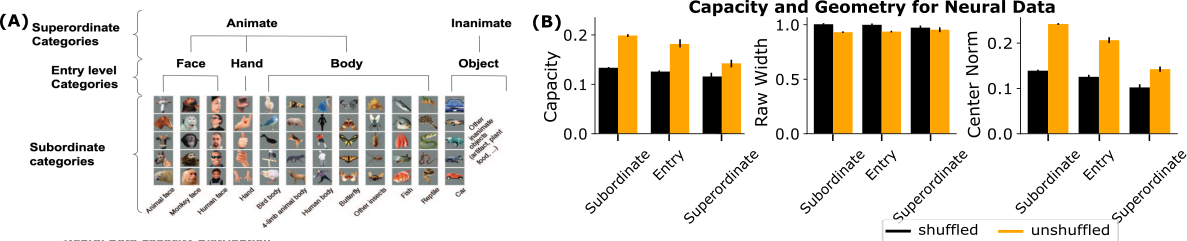
Psychological have shown that humans tend to organize objects hierarchically based on abstraction of shared attributes. Neuroscience studies have found evidence for such hierarchical organization through similarity analyses of neural activities in the monkey IT (Kiani et al, 2007, Kriegeskorte et al, 2008). In this project, we use the theory of manifold capacity (Chung et al, 2018) - a theoretical framework using statistical physics that connects object categorization to the geometry of the object’s neural manifold ([^1]: A neural manifold is defined as the aggregated neural responses to each category.) - to discern the hierarchy structure of object classification in the monkey IT cortex.
Applying manifold capacity theory shows that as the level of hierarchical classification increases (more general categories), distance to the manifold centers decreases while the size of the manifold seemingly remain constant. We hypothesize that the object manifolds are “stacked” and aligned along some axis of low variance. However, applying a whitening procedure and a rotational process, show evidence against this hypothesis as whitening and rotating stacked manifolds would both destroy the separability of the neural manifolds (as measured by capacity). We support this through simulation - generating vectors that are hierarchically correlated by adding vectors along a predetermined tree (Saxe et al, 2019).
See the talk at Cosyne 2024 linked below.